Carpentry Equipment: A Digital Toolkit for Modern Creators
When you hear the phrase Construction Work Tools Carpentry Equipm, you might picture sawdust, hammers, and power drills. Yet in the digital world, this concept has evolved into a versatile asset for communication and design. Our Special AI EPS Collections translate the tangible tools of the workshop into crisp, editable vector illustrations. This bridge between the physical craft of carpentry and digital creation unlocks a suite of possibilities for anyone needing to visually represent construction, building, or hands-on work.
What This Collection Offers Beyond the Icon
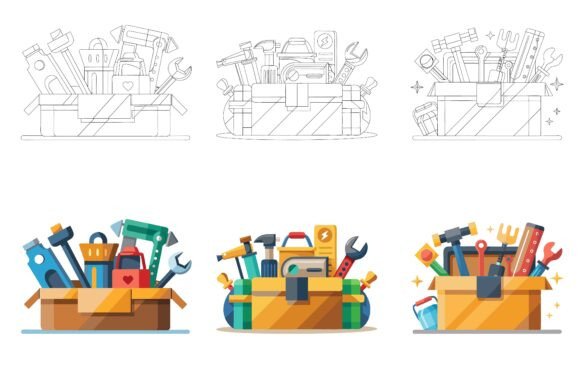
An icon set is often just a set of pictures. This Construction Work Tools Carpentry Equipm collection is built as a functional system. The inclusion of three variations means you aren't stuck with a single perspective of a tool. You might have a detailed close-up, a simpler outline, and a side-view silhouette, giving you immediate flexibility for different design contexts. The foundation is the AI EPS file, the native format of Adobe Illustrator, ensuring true vector scalability without quality loss. The companion JPG files provide quick-use raster versions.
The technical construction of these files matters as much as their visual content. Designed for both Mac and Windows users, with a neatly organized file and layer structure, they respect your time. You won't spend minutes hunting for a specific element buried in a chaotic group. This deliberate organization speaks to a professional understanding of how these assets will be used in real projects.
Key Strengths in Detail and Application
Perfection in details and consistency is not an empty claim. When illustrating technical tools, accuracy in form—the grip of a hammer, the teeth of a saw—builds trust with viewers who recognize these items. Consistency across the set in style, line weight, and visual language ensures that when you use multiple icons together, they feel like a unified family, not a random assortment. This coherence is critical for professional branding and clear communication.
The suitability for print, web, symbols, apps, and infographics addresses the multi-platform reality of modern content creation. A blogger might embed a JPG in a blog post about DIY safety. A marketing agency could use the EPS files in a large-format trade show banner. An app developer might integrate simplified versions as UI symbols for a construction management tool. An educator could build an infographic about tool history for a vocational course. This single collection serves all these environments without requiring separate assets.
Real-World Applications Across Professions
For the entrepreneur running a small construction firm, this Construction Work Tools Carpentry Equipm set becomes a branding shortcut. Instead of commissioning custom illustrations for a website or brochure, they can quickly edit these vectors to match their company colors, creating a coherent visual identity that conveys their trade expertise. A freelancer designing a client's hardware store catalog can populate layouts with high-quality illustrations instantly, dramatically speeding up the production timeline.
Marketers and publishers find immense value in such assets. Imagine creating a social media campaign around "Tool Safety Week." Having a library of editable, consistent illustrations allows for the rapid generation of posts, carousel images, and email graphics that are both attractive and thematically precise. For bloggers and content creators focused on the maker community, these illustrations elevate articles and guides, making technical content more engaging and easier to understand.
Unlocking Customization and Efficiency
The promise that you can edit it, change colors, and modify the icon so easily according to your needs is the core of its value. Vector EPS files are inherently malleable. Changing the color of a power drill from generic yellow to your brand's specific blue is a matter of a few clicks. You can isolate parts of an illustration—perhaps using just the circular saw blade in a diagram—without degrading the image. This level of control turns a purchased asset into a tailored resource.
This efficiency translates directly into productivity. Time saved searching for disparate images or manually creating approximations of tools is time gained for the actual creative or strategic work. The improved user experience for the designer—working with clean, predictable files—often results in a better end-user experience for the audience viewing the final design, which feels polished and authoritative.
Practical Considerations Before You Use
While the benefits are clear, integrating any asset into your workflow requires some forethought. First, assess your primary software. If your work revolves around Adobe Illustrator or other professional vector editors, the EPS files will be your mainstay. If you primarily work in simpler applications like basic presentation software, the ready-made JPGs might suffice. Understanding your own typical output—is it mostly for web, or do you regularly need high-res print?—will guide how you use the different file types.
Also, consider the scope of your project. If you need to depict a very niche carpentry tool not covered in a generalized set, this collection might serve as a fantastic base but not a complete solution. However, for representing common Construction Work Tools Carpentry Equipm—hammers, saws, screwdrivers, measuring tapes, safety gear—it likely covers the vast majority of needs. Its strength is in providing a reliable, editable core library, not an exhaustive encyclopedia of every possible tool.
Finally, the real test is in the modification. The true value of a vector collection is realized only when you adapt it. Don't just use the icons as they arrive. Take the step to recolor them, combine elements, or simplify them further for your specific context. This active implementation turns a purchased product into a genuine part of your own creative toolkit.
From Digital Files to Tangible Impact
In essence, this AI EPS collection demystifies the visual representation of a physical industry. It allows professionals, educators, and creators who are not illustrators themselves to communicate ideas about carpentry and construction with clarity and style. It supports branding, enhances educational materials, speeds up content production, and elevates the visual quality of both digital and print media.
So what are you waiting for? The decision hinges on your current needs. If your work involves communicating about building, craftsmanship, tools, or DIY, having a ready-made, professional-grade visual lexicon at your fingertips removes a significant design hurdle. Buy now and start using this awesome illustration set not as mere decorations, but as functional components in your projects, helping you build clearer, more effective, and more engaging visual communications.