City Architecture: Modern Thin Line Design in the Creative Workflow
In the digital landscape of visual communication, clarity and aesthetic precision are paramount. For professionals tasked with conveying complex urban concepts, a clean, scalable visual asset is not just a luxury; it's a fundamental tool. This is where City Architecture - Modern Thin Line Design enters the process, offering a distilled, elegant representation of metropolitan forms. It fits into workflows as a ready-to-use, highly adaptable illustration set, designed to accelerate project development while maintaining a consistent professional tone.
Unlike generic stock imagery or time-intensive custom drawings, these AI EPS files serve as a foundational visual library. They are engineered for integration, acting as a bridge between initial concept ideation and final design execution. For a marketer planning a campaign for a tech startup headquartered in a vibrant city, or an educator crafting a module on urban planning, these assets provide an immediate, coherent visual language that aligns with modern design sensibilities.
Integrating Thin Line Architecture into Your Project Pipeline
The utility of City Architecture - Modern Thin Line Design is most evident when viewed through a process lens. Its application is not confined to a single phase; it can be leveraged throughout a project's lifecycle to enhance clarity, speed, and consistency.
During Preliminary Planning and Concept Development
Early stages often require quick visualization to solidify ideas and communicate with team members or clients. Here, the thin line illustrations function as schematic placeholders. A UI/UX designer wireframing a city-focused app can drop these icons into mockups to represent location services or urban data points without committing to final artwork. A blogger outlining a post on sustainable architecture can use the JPG previews to quickly draft graphics, ensuring the visual theme supports the written content from the outset. This early use prevents later misalignment and streamlines the approval process.
At the Core of Design Execution
This is where the set’s technical specifications directly impact workflow efficiency. The AI EPS files, with their neatly organized layers, are designed for both Mac and Windows users, eliminating compatibility concerns that often stall collaborative projects. The clean layer structure means a graphic designer doesn’t waste time hunting for elements or disentangling grouped objects. Modifying the icon to match a brand’s color palette—a common requirement during execution—is a straightforward task. You can edit it, change colors, and modify the icon with precision, ensuring the asset evolves seamlessly into the final design rather than being a static, limiting component.
For Final Output and Quality Control
Perfection in details and consistency is a hallmark of professional output. The vector-based EPS format guarantees that the illustrations remain sharp and scalable whether they are suitable for print in a brochure, embedded in a web interface, or used as symbols within a mobile app. This versatility removes the need to source or create separate assets for different media, a common point of fragmentation in projects. A freelance creator delivering a complete brand package to a small business owner can use the same set of city icons across the logo, website infographics, and printed promotional materials, ensuring a unified brand experience. The inherent consistency of the set acts as a built-in quality control mechanism.
Practical Implementation and Workflow Synergy
Successful integration hinges on understanding how City Architecture - Modern Thin Line Design interacts with other tools and resources in a typical creator’s ecosystem.
Consider an entrepreneur developing a presentation for investors. Their workflow might involve a slide deck tool (like PowerPoint or Keynote), a primary brand style guide, and data visualizations. The thin line illustrations can be imported directly into the presentation software, recolored to adhere to the brand guide, and combined with charts to create custom infographics that explain market penetration in different urban zones. The asset interacts not as an isolated graphic, but as a malleable component that enhances the primary message crafted by other tools.
For a publisher or educator producing digital materials, the set integrates with authoring platforms and LMS (Learning Management Systems). The JPG files provide quick embed options for draft versions, while the EPS files allow for deeper customization for printed textbooks or high-resolution online publications. The organized file structure means that even when handing off assets to a production team, the files are self-explanatory, reducing the need for extensive documentation and preventing errors in the final assembly.
Key Factors for Smooth Adoption
To leverage these illustrations effectively, a few practical observations can guide your approach:
- Preparation: Before purchase, audit your current projects and future pipelines. Identify where a consistent urban visual motif could simplify tasks—from social media templates to report headers.
- Usability: The ease of editing is a core feature. Familiarize yourself with the layer names in your vector software (Adobe Illustrator, Affinity Designer, etc.) upon first opening the files. This upfront minute of exploration saves hours later.
- Organization: Treat the downloaded set as a new resource in your digital asset library. Store it logically alongside other icon sets and templates, so it becomes a go-to option for city-related themes.
- Long-Term Use: The timeless thin line style ensures the assets won’t feel dated quickly. Think of them as a long-term investment for your toolkit, usable across multiple projects and client types for years, enhancing your overall efficiency.
Outcomes and Enhanced Creative Capacity
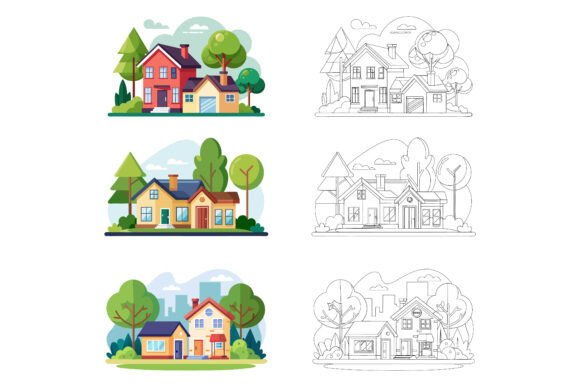
The ultimate value of a specialized resource like this illustration set is measured in outcomes: saved time, elevated quality, and expanded creative capacity. By providing 3 variations, it offers flexibility without overwhelming the user with excessive choice, which can paradoxically hinder productivity. A professional can select the variation that best fits the current project’s mood—perhaps a more detailed version for a high-end print piece and a simpler one for app UI.
This approach to resource integration is process-oriented. It moves beyond merely acquiring a graphic to thoughtfully embedding a high-quality, adaptable component into your standard operating procedure. For the hobbyist designing a personal blog about city travel or the productivity-minded user streamlining their content creation, it removes a common bottleneck—the search for appropriate, editable graphics—and replaces it with a reliable, on-hand solution.
In a practical workflow, every minute saved on asset sourcing or modification is a minute gained for higher-level creative thinking, strategy refinement, or client communication. City Architecture - Modern Thin Line Design is engineered to facilitate that gain. It’s a specialist tool for a common need, enabling you to focus on the message while it handles the medium. The next step in that process is integration: acquiring the asset and placing it into your active workflow where its design and structure can begin delivering immediate value.